
Narcissistic Abuse Series #8 - The Narcissistic Relationship Cycle
The end of my first marriage began when my ex-husband ran off with a teenager in the middle of the night. You might think I knew this was the end, but I’d been programmed for so long that I believed him when he told me he was “mentoring” her. This kicked off a long chain of events so bizarre that I describe them as “Oprah movie worthy.” As I desperately tried to maintain a sense of normalcy for my two young children, the only part of my life that was within my control was me, so I worked on me, trying to make sense of it all.
His behaviors and speech so defied reality that I genuinely believed he was having some kind of psychotic break. If I could just convince him to get help, everything would be okay, because, after all, that’s what love does, right?
But in my quest for answers, I began to notice something strange – his behaviors and words were not unique to him. They were eerily similar – sometimes even identical – to those in the stories of so many others who were also seeking answers.
The moment I started to identify patterns in his words and behaviors was the moment I realized he wasn’t uniquely troubled. I had begun to uncover the narcissist playbook.
Maybe, like me, you’re searching for some way to make sense of the crazymaking that you’ve endured. You’re wondering How did I get here? What happened? Why did I put up with the toxicity for so long? How did I not see the red flags?
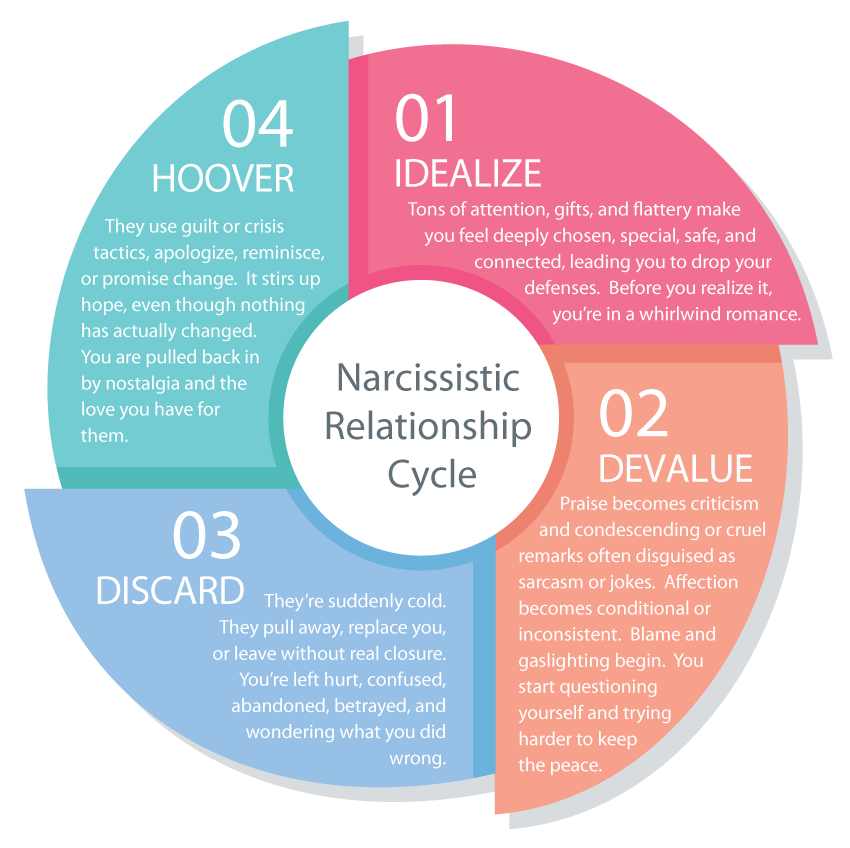
Let me introduce you to the narcissist relationship cycle.
1. The Idealization Stage: “I’ve never felt this close to anyone.”
This is the phase that hooks you, where the Love Bombing happens.
They seem deeply interested in you. They’re emotionally intense, attentive, and affectionate. They listen closely to your stories, your pain, your dreams, and then reflect it all back to you like a mirror. You feel heard, understood, chosen, and special, and it seems almost too good to be true.
Things often move fast, and closeness and future plans are rushed. Big feelings. Big promises. Big connection. You think Finally. Someone who really sees me.
You feel safe and hopeful, like you finally found “the one,” but what’s actually happening is emotional bonding before real trust has time to grow. Underneath it, they’re building dependency. The narcissistic partner is studying you to become what you need.
During the discard stage, my ex-husband told me, “When we were dating, you were dating me, but I wasn’t dating you, I was studying you. After 70-plus women, I knew exactly what to say and do to get you to do what I wanted.”
2. The Devaluation Stage: “Why Does Everything Feel So Hard Now?”
This stage is about power. Once you’re emotionally invested, the shift begins, not all at once but just enough to make you uneasy, just a feeling that something is wrong.
Suddenly, jokes start to sting, sarcastic comments are a little more personal, and compliments turn into critiques. They start criticizing your tone, your reactions, or even your personality, telling you that you’re too sensitive, too needy, or too dramatic. The affection that drew you in at the beginning is withheld or given conditionally. When you start to question things, they rewrite events causing you to doubt your memory. You might be blamed for their bad moods or behavior, and they may even try to create jealousy or triangulation by involving other people in some way.
You feel anxious, confused, and like you’re “walking on eggshells.” You start explaining yourself more, apologizing more, and shrinking a little. You find yourself thinking:
If I can just say it better…
If I can just be calmer…
If I can just not upset them…
You find yourself putting in all the effort to figure out how to get back to the version of them from the beginning, the one who felt safe.
I was the “traditional” wife and mother even as I was also running a business and working from home. I did everything for my ex-husband, even his clothes shopping, but it was never enough. He convinced me that I had mental health problems even though I had no idea what he meant. Once he arrived home from work breathless and with a worried look on his face. When I asked him what was wrong, he said that he had envisioned a scene at home where I had murdered our child, so he “drove 90 miles an hour” to get home. When I questioned where this was coming from, he gave no specifics, instead saying, “As a police officer, I’m trained to recognize mental health issues.” I had no idea what he meant by “issues,” but when I suggested that I could get counseling, his response was that we couldn’t afford that.
Who I was and what I believed I could trust about myself was eroded little by little, and I didn’t even understand why.
3. The Discard Stage: “How Did We Go From That to This?”
This stage often feels sudden, even if the warning signs were there.
They may go emotionally cold, break up abruptly, cheat or even replace you, act like you’re the problem, and refuse any kind of real closure. This stage feels brutal because it’s not just losing the person, it’s losing the future you thought you were building together, and the suddenness of it all only magnifies the hurt.
You’re left shocked, heartbroken, and questioning your worth, and the worst part is that you’re still bonded to who they were in the beginning.
Even while my then-husband was living in his truck with the teenager he’d run off with, he was telling me I was the problem. I stopped answering my phone because he was psycho-dialing me 60 times a day, and within only a few hours, I was told that it was my fault I had forced him to “find a new friend” because I wasn’t there for him.
What typically triggers the discard stage is that something has changed with the narcissistic supply. They were drawn to you because you supplied them with empathy, compassion, understanding, or something else valuable to them – perhaps you were even “moldable” or “teachable” so they could shape you to what they wanted. In my case, my ex-husband told me that he never loved me but married me because I was “good” and he wanted to prove to his parents that he “could have a normal family.” He'd found someone young, trainable, and who was a greater source of narcissistic supply.
As you begin to push back against mistreatment and advocate for yourself, you start to grow and set healthy boundaries. Those healthy boundaries are the very thing that start to loosen the narcissist’s control over you, so they start to look elsewhere for their supply. There may be no indication whatsoever that this is happening until they have already hooked someone else in Stage 1, which adds to the abruptness of the discard.
In some situations, the discard stage can also be one of the most dangerous stages for the survivor, because the narcissist engages in something anecdotally called “scorched earth.” This is where they employ extreme, retaliatory tactics to destroy a parter or spouse’s reputation, finances, or peace of mind. This is partly to silence the victim but also partly to minimize the seriousness of their own actions in the eyes of others.
Unbeknownst to you, they may set up narratives with friends, family, or even professionals that you have mental health issues, are financially unstable, or are a bad parent or employee (see my blog post on Flying Monkeys). They may use the court systems to legitimize their behaviors and make them look like the victim and you like the abuser.
Friends and family whom you previously trusted may be turned against you. If the narcissist has ever been physically abusive, this kind of abuse may intensify to dangerous levels, and if they have never been physically abusive, it may occur during this stage.
My ex-husband was predominantly emotionally and verbally abusive during our marriage, but in the discard stage he became volatile, unstable, and dangerous. He threatened me with a gun, tried to break into my house multiple times, and even tried to kill me. If you feel at all in danger, please take steps to protect yourself. Reach out to someone you trust and seek help. If you are ready to leave your narcissistic partner or spouse, I would encourage you to seek professional help in preparing for any major moves to ensure that you are protected.
4. The Hoovering Stage: “Maybe They Really Have Changed…”
“They want access to you again, not accountability with you, so if you return, the cycle restarts.”
After some time passes — days, weeks, months, maybe even years — they may come back. It’s usually when they’re no longer getting their narcissist supply from whoever they’re with at the time. During this stage, they might apologize, tell you how much they miss you, tell you you’re the only one who understands them, promise things will be different, and bring up shared memories.
It feels familiar, comforting, and hopeful, because maybe, just maybe that thought you had deep down that they really did love you is true after all. But with a narcissist, usually what’s happening isn’t change, it’s a reset.
They want access to you again, not accountability with you, so if you return, the cycle restarts.
► In the narcissistic relationship cycle, you may not always go straight through every stage in order — you may bounce back and forth between stages. For example, as you start to find your voice and speak up for yourself, the narcissist may take you back to Stage 1 as they try to convince you that things aren’t as bad as you’re starting to realize they are. As soon as you are hooked (again) and are no longer upset, you’ll find yourself back in Stage 2.
It took me a long time to process and accept that I had been made a part of this cycle and nothing I tried was changing it or making it better. Through the process of healing, I finally came to realize that I could only decide whether to jump off the merry-go-round.
Next in this blog series: When “We” Erases You: Enmeshment and Narcissism
Whether you’ve already broken free from a narcissistic relationship or are just beginning to notice the painful patterns that have kept you stuck, healing often begins with awareness. You might be realizing that no matter how much you gave or how carefully you tried to avoid conflict, the narcissist’s reactions never changed—or you may be trying to make sense of the confusion and pain left behind after being discarded.
Wherever you find yourself in this process, know that you are not alone. Many have walked this same path and found their way to peace, clarity, and self-trust again. Working with a therapist who understands narcissistic abuse can help you process what you’ve been through, rebuild your confidence, and begin to create a life that feels safe and authentic.
If you’re ready to take the next step toward healing, reach out to Novus Psychotherapy & Counseling Center for support today. You deserve to feel whole, grounded, and free.